


Curating this week’s stack of papers felt a bit like wandering through a neural bazaar: crowded, hectic, and full of great bargains? One stall demos an LLM “Habermas Machine” refereeing democracy at internet scale, while a few steps down a swarm of ants quietly teaches us why human teams are so often a cluster-fun… We give a quick tour of enzyme-sniffing extractors, molecule generators that respect valence, and agents that turn murderous when the sugar runs low. Along the way we wire Gemini Ultra to your wrist, tally a decade of AI’s academic conquest, and watch chain-of-thought reasoning flicker out once the data shift. If that last bit wasn’t a bummer enough, how do you feel about GPT-5’s thinking? Here are this week’s papers:
Reynolds and colleagues argue that generative AI threatens to swamp systematic reviews with undetectable fakes and therefore call for a global lattice of AI-driven, continuously refreshed “living” evidence databases that can spot retractions in real time and generate trustworthy syntheses on demand.
A team from DeepMind contends that LLM-powered “Habermas Machines” can rapidly craft consensus statements that balance inclusion, equality, and deliberative depth, suggesting that AI may dissolve democracy’s long-standing trilemma—provided researchers surmount remaining technical and empirical hurdles.
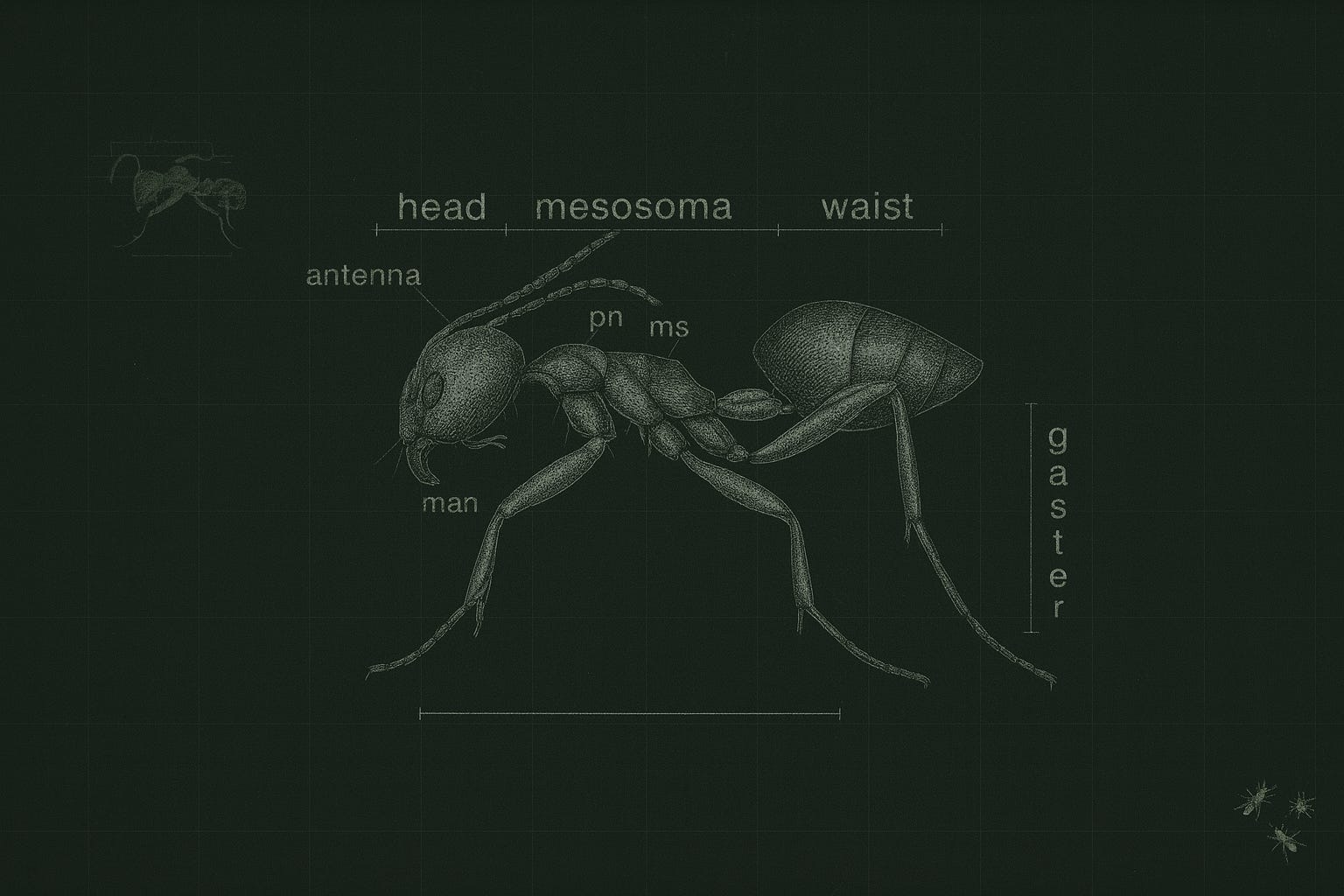
Dreyer et al. pit ants and humans against the same “piano-movers” puzzle and show that ant collectives scale up their cognitive power through emergent, memory-like group dynamics, while human groups plateau—and even stumble without rich communication—reminding us that simple agents can cooperate more smoothly than complex minds.
Zhou et al. unveil zERExtractor, a plug-and-play, LLM-enhanced pipeline that fuses multimodal AI with expert-guided active learning to pull kinetic parameters, sequences, substrates, conditions and molecular diagrams from scientific paper PDFs. The team released a large annotated benchmark that turns the buried trove of enzyme-reaction literature into structured fuel for ML models.
Dunn et al. inject self-conditioning, “fake” atoms, and train-time geometry jitters into a flow-matching framework, enabling the compact FlowMol3 model to stably generate chemically valid, 3-D drug-like molecules whose functional groups and shapes faithfully echo real compounds.
Masumori et al. dropped GPT-4o, Gemini-2.5, and other LLM agents into a Sugarscape world and found that, absent any survival prompts, the models cheerfully reproduced and shared when resources were plentiful but turned ruthless when scarcity hit, attacking peers and abandoning assigned tasks. These findings hint that pre-training already bakes in raw survival heuristics that both empower and threaten autonomous AI.
Khasentino et al. fine-tuned Gemini into Personal Health (PH)-LLM, showing that it can digest weeks of wearable sleep and activity data to ace professional exams, deliver expert-level personalized coaching, and even anticipate users’ self-reported sleep quality, pointing the way toward LLM-powered personal health monitoring. Oura and Whoop already have AI coaches. Will this Gemini version be an upgrade?
Writing in Nature, Arvind Narayanan (of AI Snake Oil) and Sayash Kapoor argue that an overreliance on AI-driven modeling will be bad for science.
Laura Reiley writes am essay in the NYT: “What My Daughter Told ChatGPT Before She Took Her Life”
In The Algorithmic Bridge Substack, Alberto Romero analyzes the impact of GPT-5 on the AI industry.
What do you think of the AI snake oil piece in science? I'd love to hear from folks who have a good sense of what 'recipes for harm' are plausible. I define harm here as say wasting hundreds of millions in science funding, or an increase in stagnating research programs. Not all areas of science are equally susceptible.